
As early as the 1870s, logs were transported from Atmata to Minija, and from there—via the new King Wilhelm Canal—to Smeltė, a suburb of Klaipėda. In 1875, over a thousand ships and several thousand rafts passed through the canal. The canal became the main transportation artery for timber and other goods, and rafting remained the simplest and most economical form of log transport until the mid-20th century.
An integral part of this work were the raftsmen—strong, brave, and resilient men. After 1928, only those who signed a contract and pledged property or a sum of money equal to or greater than the value of the raft could become rafters. Rafting operations were carried out in groups of 8–20 people, with additional workers laboring on the shore. Tying the rafts required meticulous care: the logs were bound tightly and neatly so that they would retain their shape while floating.
The rafts were floated from the spring thaw until late fall, when the water froze over. On the Minija River, they had to be pulled against the current, sometimes for about 18 km. A single raft train was divided into three sections, each pulled by six men on both sides of the riverbank. A long column of rafts could stretch for about 250 m. The rafts were also pulled by horses.
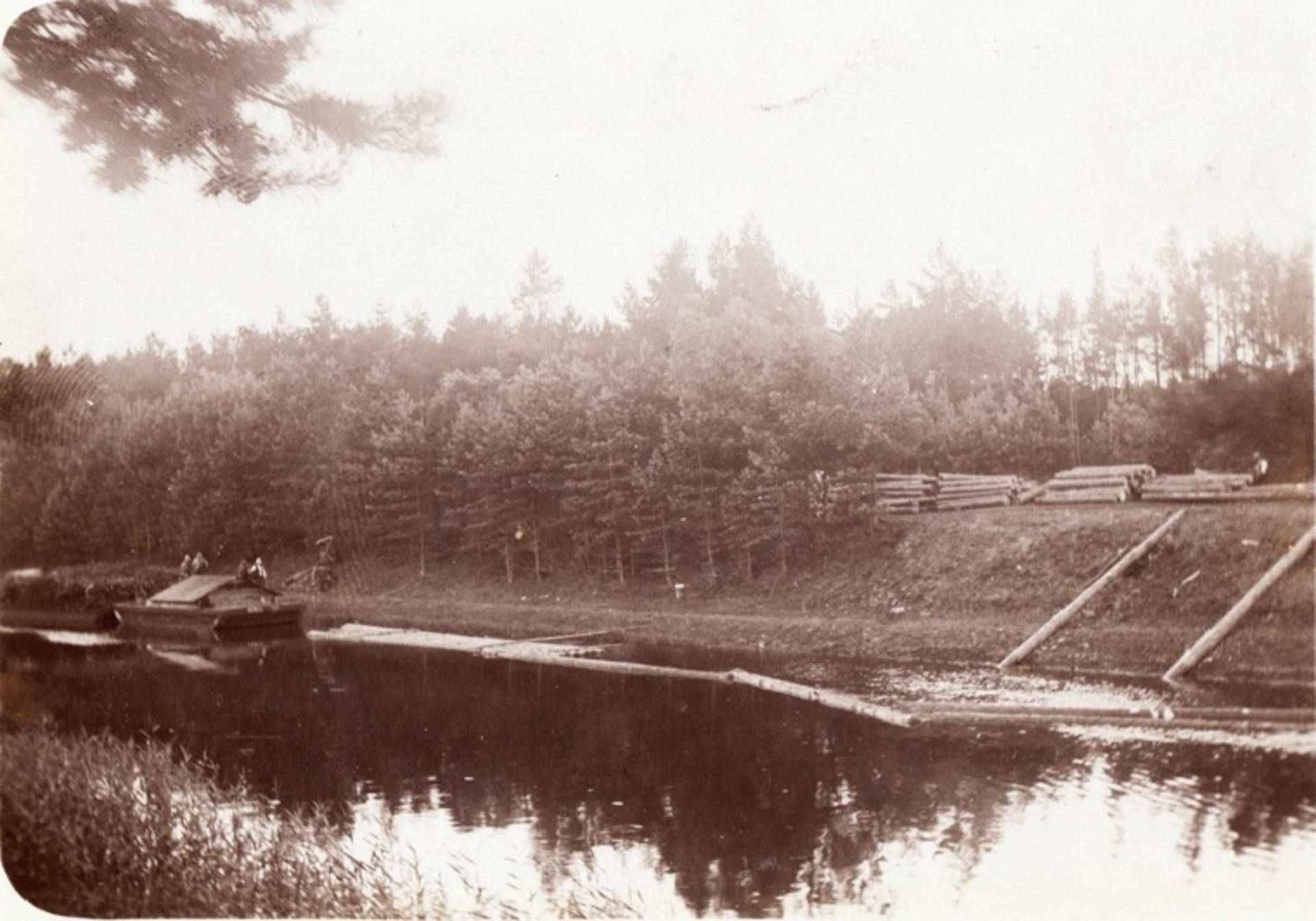
On the King William Canal, near Jokšai and Venckai, log floating and transport operations also took place around 1925–1930 (as shown on the display). A small log-floating station operated here. The work barge pictured at the shore is a small wooden vessel with low sides, designed for transporting timber, securing rafts, and performing technical maintenance. It features an enclosed cabin where workers could rest, sleep, or take shelter from bad weather. The barge usually carried a toolbox, a stove, and sometimes even a few days’ worth of food supplies.
The four men on the barge, working with the log barrier, most likely belonged to a group of log binders and were responsible for gathering the floating logs. The man standing on the logs is steering the drift using a long pole or hook. Meanwhile, the others are arranging the logs, holding them in place, or tying them into rafts. On the slope, you can see piles of several logs, and nearby—log-launching lines: two logs placed diagonally on the shore, forming log-launching tracks called “rogės.” The logs were rolled down these tracks into the water.
The King William Canal is not only a technical achievement but also a testament to centuries of labor, cooperation, and the tradition of timber floating.