
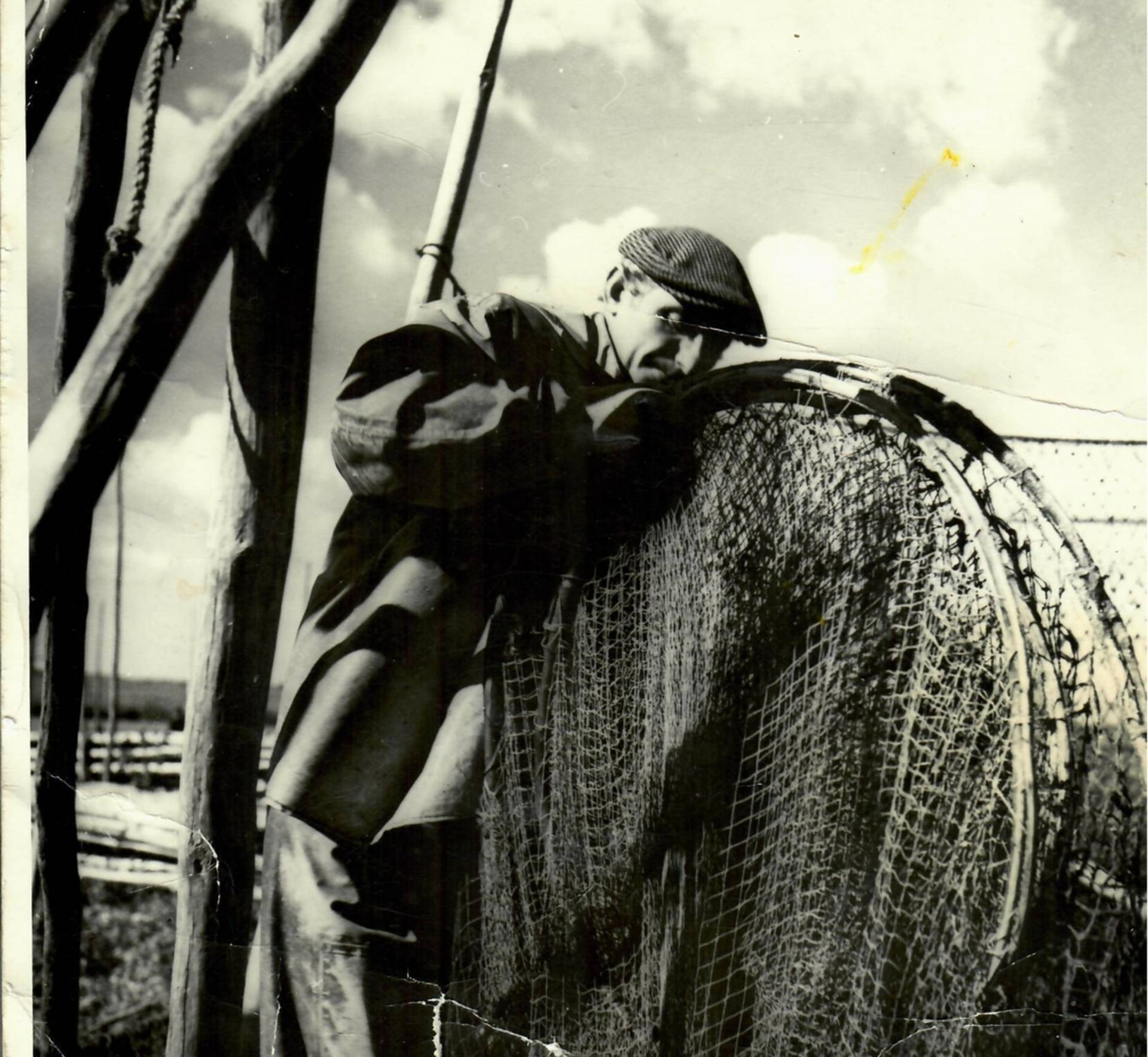
Fishing nets were invented independently by people in various parts of the world as far back as the Stone Age. It is believed that the creators of these nets also invented the art of weaving. The earliest nets were woven from natural fibers (grass, flax, wood fibers, willow, and hemp). The oldest known net, dating back to around 8300 BCE, was made of willow (osier) fibers and measured approximately 27–30 meters in length.
The fishing nets used in the Curonian Lagoon were divided into towed and set nets.
The most popular was the “kiudelinis” net, designed for catching fish in the lagoon. This is a large, basket- or sack-shaped net towed by rowboats. Fish swim into it and are trapped in a special “kiudė” (sack) section.
Equally popular was the “bradinis” net—consisting of two wings (long sides), which could reach 160–180 meters in length, and a central bag (metrica). Set nets were designed so that fish would swim into them on their own. The choice of net depended on the species of fish and its migration route. Gates—large-mesh traps—were among the most important stationary fishing gear in the Curonian Lagoon. They were used to catch larger fish, but especially smelt during the spring spawning season. Gillnets—stationary nets designed to entangle fish by their gills.
Venteriai, staginiai, ailės, and bučiai are various smaller, trap-type (trap-style) and bottom-fishing gear that were used as supplementary gear or in specific locations. Their purpose is similar to that of a gate—to catch fish using the trap principle, enclosing them in a woven cage or bag. It is also worth mentioning “ūdas”—these are lines with hooks that are lowered to the bottom. Although they are not nets, they were an integral part of lagoon fishing, designed to catch bottom-dwelling fish—especially eels and flounder.
Depending on the type of net, specific types of net boats were built—each net required its own suitable boat.
To ensure a successful catch, prevent the nets from tangling, and ensure the fisherman returned with a basketful of fish, the nets were salted or sprinkled with snake water, and a jakšis (axe) was placed at the bow of the kuršvalte, with its blade facing the direction of the wind.